Conveyor Feeding Systems with Parts Feeders

You may have seen a parts feeding system with a conveyor added for a variety of reasons. A normal system usually has a straight-line vibratory unit, or a gravity fed track. However, sometimes these components cannot perform as well as a conveyor. Therefore, the application at hand may require a conveyor to successfully fulfill the production requirements.

Some factors to consider when choosing a conveyor over an inline or gravity track would be that they can travel at a much faster flow rate per minute. You will see more inches per minute out of a conveyor, so this helps to integrate with high speed systems such as packaging machines and fast-moving assemblies. In addition to the high feed rate these conveying systems can also be utilized to feed out to a point that is very far away from the main bowl feeder discharge. This allows the customer to offset the whole feeding system while the conveyor reaches into the machine to deliver the parts accordingly.

Our customers love our conveyors because we use modular machined units that are equipped with oriental motors and drivers. The gear heads are guaranteed for life and we have never had an issue with those components after high stress in the field. With our LP (Low Profile) design we can get into very tight areas. This is especially useful for existing tooling integration. The profiles of the conveyors can be changed from width to length as needed for the application. FCI can change the mounting package to an undermount setup or direct shaft coupling. Also, we offer multiple belt options such as PVC, Urethane, Fabric, Transparent, and other materials.  These are just some of the options we offer to provide that extra flexibility during the design phase of the project.

If you think a conveyor system will be needed on your next feeding project, please reach out to us today. Our engineers have years of experience in the field and can find the correct unit for your application.
Air-Track Systems in Place of Inlines and Conveyors

Under certain circumstances a part must feed to an extended distance away from the bowl center. The typical vibratory inline can only support about 8-12” of overhang off the plate before it becomes sporadic. Conveyors can only go so far but the transition and costs can get complicated. There is an alternative solution to these problems. That fix would be implementing an air-track in place.

FCI Air-Track systems typically consist of a blower system with flexible air tubing. This tubing connects at the back of the track and provides a consistent flow of air down the main channel of the track frame. The track frame usually consists of steel or stainless-steel tubing equipped with angled holes so the air escapes in the direction of feed. This design allows for a linear motion without adjusting flexible air-jets or air-knifes. It is a fixed setup that is consistent and efficient.

Air-Tracks have several pros, one being that they can be machined at very long lengths. Machine builders and integrators love this because it allows us to supply a track that is capable of running through their machine enclosure to an area of interest such as a pick and place mechanism or rotary actuator. No electronics exist on an air track except for the full track switch sensor and the blower system. Everything else runs off the air flow produced. This air flow can produce a very high feed rate per minute which is also why many of our customers elect to choose this type of system over a standard vibratory inline or conveyor.

If you think this type of system could be used on your next project, please reach out to us and a member of our team can provide some insights.

NEW TECHNOLOGY: Color iVU Vision Systems for Color Orientation and Inspection

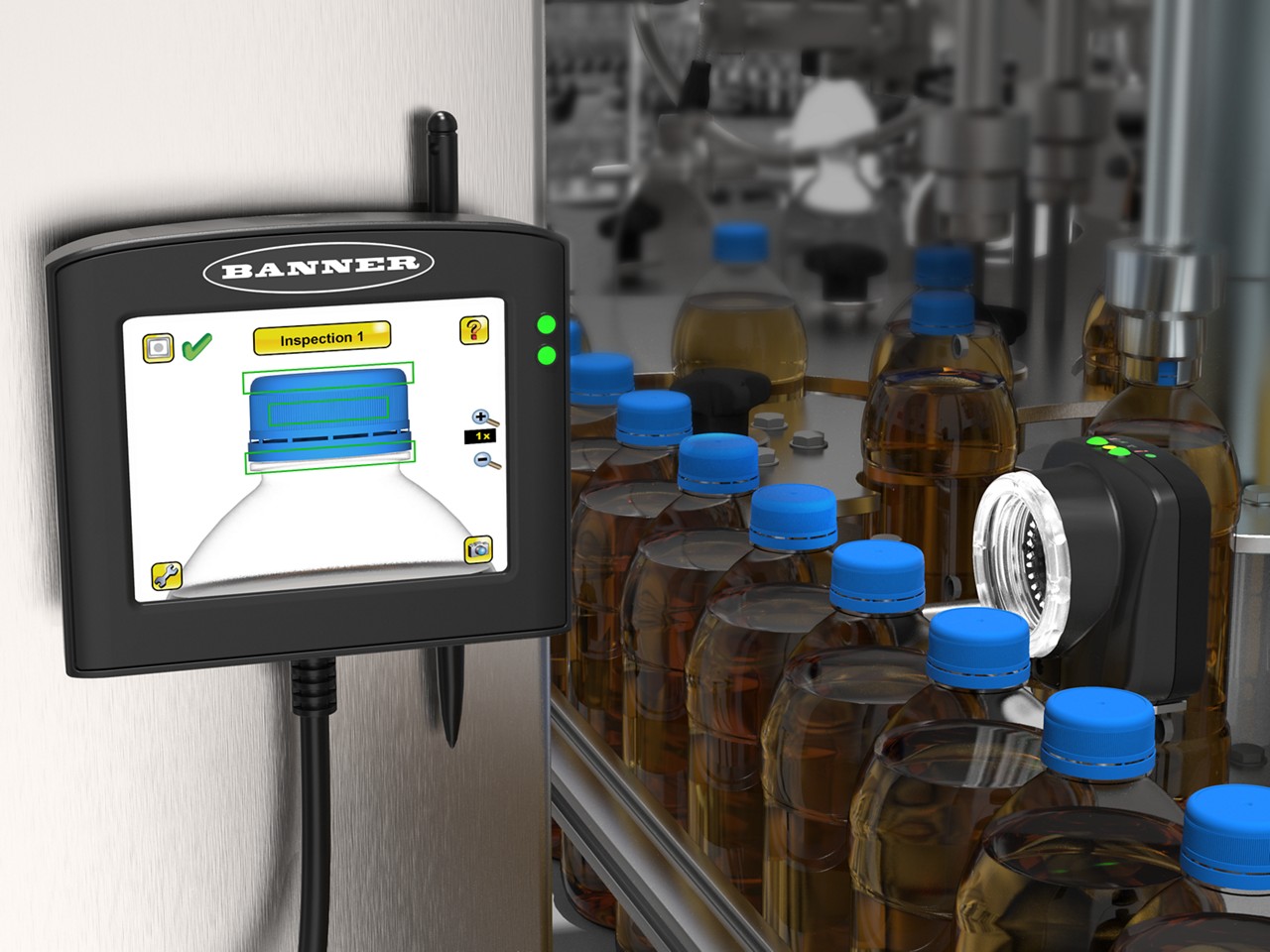
Banner has recently introduced a new addition to their iVU line. They have added a sensor capable of color inspection while also still having the ability to be reprogrammed on-site. The traditional ivu could only handle grayscale applications and patterns. With this added ability we have seen many opportunities for applications involving quality control and orientation based on color.

Typical contrast sensors have their core capabilities and don’t always work for some applications. The older contrast sensors were not user-friendly and didn’t have much flexibility. Now with the iVu integration the part changeover processes are seamless for the end user. Having that ability to see what is going on with the built-in screen is a big pro to many production managers and operators.

The iVu Color sensor implemented with a vibratory feeder bowl can monitor parts for color or color variations while also looking at type, size, orientation, or position. The three main functions of this color system are average color, color area, and color compare.  Some examples of applications would be checking for stain color on wood or metal, verify color on bottle cap, confirm label color on a package, verify label based on color, monitor ink color changes over time, and provide color information for part sorting. The most utilized feature of this vision system for vibratory feeders is the part sorting based on color.

If you think this system would be a good addition to your next feeding system, please consult us today.

PRESS RELEASE: Automated Feeding Systems Sweeping Across America

The last decade has been a revolutionary time in the parts feeding arena. More and more large corporations and small business are beginning to automate due to the high cost of production and wage expenses. Simplified tasks such as pick and placing, and part presentation are no longer a manual operation by an employee. Vibratory Feeder Systems have reduced the amount of work needed and have accelerated the rate of production.

Coast to coast people are no longer hand loading machines for assembly. Instead systems such as variable parts feeders and centrifugal feeding systems are being implemented.

With these systems in place it is easy to see how manufacturing plants and production teams are using these to their advantage. Some systems can handle the bulk loading, part orientation, and part presentation in a very small footprint without supplying anything else. These “stand alone” systems are what we specialize in and why we get so many requests around the country.

If you ever get the chance to visit an automotive, industrial, or packaging plant in the US you will probably find a parts feeder or vibratory feeder being used with the whole assembly station. We are glad to supply these systems and provide support because that is our specialty in this industry.

Consult us today for your next application and one of our engineers will be glad to help.

Food Grade Applications(FDA Compliant)

FCI has been building vibratory feeder bowls and parts feeders for a variety of food industries. Some of the product we built machines for would be things like bulk salt, pretzels, candy , marshmallows. We have also constructed machines capable of processing packaged goods like coffee pods, granola bars, freeze dried foods, and even some empty containers that are required to be filled with a food or beverage.

Under certain circumstances an application that is involving food(packaged or un-packaged) may require a vibratory feeder to be implemented. Such applications are not common everyday but are ideal for packaging, counting, weighing, or quality control inspection. A typical feeder would consist of standard materials but a food grade(FDA compliant) feeder is required to have certain specifications such as 316L stainless steel on all surfaces and “pit-free” finishing. Not only does the finishing matter in these environments but also the coatings and coverings of all equipment that have rust concerns. These concerns can be eliminated by using food-grade stainless steel on all surfaces contacting the product and around product. Everything else that must remain regular steel can be coated in a 2-part stainless steel epoxy called Steel-IT or Surlyn Coating(resembles a golf ball coating). Nickel plating and adding shrouds is also optional if the conditions are critical such as a wash-down room.

In the event that a feeder is needed for you next food grade application please consult us first so we can determine what system is best suited given your project requirements.